

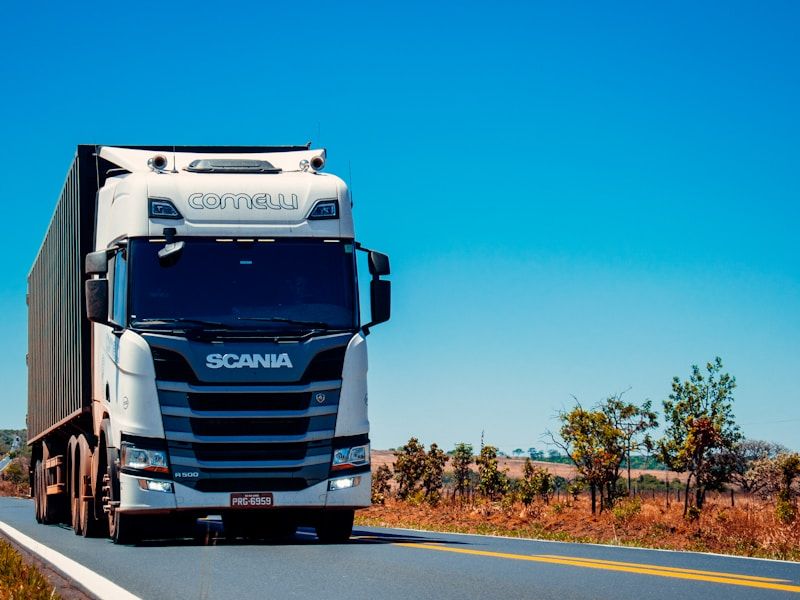
A transport depot owner can be carrying four kinds of debt at once. There is the loan on the depot and its yard, chattel mortgages on the prime movers with balloons due at the end, and finance on the trailers. A balloon is a lump sum, set when a truck is financed, that falls due with the last repayment. There is also an overdraft that pays for diesel and wages until customers pay on the terms on their invoices, weeks after the fuel and wages have gone out. This guide sets those loans side by side, shows what refinancing each one can change, and explains what the records of a freight business show.
Are the balloons on two of your prime movers due inside the year, with the overdraft already carrying this month's fuel? Has the depot gone up in value since you sealed more of the yard, while the trucks sit on finance at higher rates than the property? Do diesel, tyres and driver wages go out every week while your biggest customer pays at 60 days? Have you put off looking at it because the trucks, the trailers and the depot are each with a different lender?
Australian roads carried about 253 billion tonne kilometres of domestic freight in 2024-25, according to the Bureau of Infrastructure and Transport Research Economics. On contract freight, the fuel, the driver and the truck are paid for before the customer pays the invoice, and a depot owner's overdraft and loan repayments fall due inside that gap.
Ardent Capital Group can take you through refinancing the depot, the prime movers, the trailers and the overdraft, and we would be glad to start with whichever of them is due first.
When the balloons fall due on a depot owner's trucks
The balloon on a truck contract arrives as one large sum, on a date set years earlier when the truck was first financed.
A chattel mortgage is a loan where the business owns the truck from the start and the lender registers its interest over it. A prime mover bought on a five-year chattel mortgage can carry a balloon, set at signing. Holding that sum back to the end kept the monthly repayment lower for five years. At the end, the business pays the balloon, refinances it, or trades the truck in.
The balloon can land while invoices for loads already delivered are still waiting on customer terms. The depot may also hold equity built up since settlement: the gap between its value and the loan against it. A refinance can bring these debts together or keep them apart.
Example: a depot owner's loans side by side
A depot business takes on its debts one at a time, as the site is bought and contracts are won. Laid out together, they show which falls due first.
These round numbers describe one depot owner, made up to show a mix of debts we can assist with. The owner's company runs from a depot it owns: a shed, a workshop and a partly sealed yard, valued at about $3.0M. Two prime movers were bought for about $250k each on 60-month chattel mortgages with a 30% balloon, and 8 repayments are left. The overdraft is secured by a general security agreement, a claim over all of the company's assets. The balloons sit on the prime movers.
| Debt | What it paid for | Secured by | Owing | Time left | Each month |
|---|---|---|---|---|---|
| Loan on the depot | Shed, workshop and yard | First mortgage over the depot | $1.8M | 16 years | $15,610 |
| Chattel mortgages on two prime movers | Two prime movers, now about 4 years and 4 months old | The trucks | $206k, with $150k of balloons due at the end | 8 months, then the balloons | $8,390 |
| Chattel mortgage on the trailers | Curtainsider trailers | The trailers | $150k | 40 months | $4,350 |
| Overdraft | Fuel, tyres and wages between customer payments | A general security agreement over the company | $150k drawn of a $200k limit | Reviewed each year | $1,250 interest |
| Total | About $2.31M | $29,600 |
Rounded. For the arithmetic we have assumed 7% on the loan on the depot, 9% on the chattel mortgages and on any new loan against the trucks, and 10% on the overdraft. They are there to make the sums work and are not rates on offer today.
The two trucks owe $206k, repaid at $8,390 a month for eight more months. Of that, $150k is the balloons, due in month 8. The overdraft has $50k left to draw.
How a refinance changes a property or equipment loan
A refinance can change three parts of a loan. Each one moves the repayment that goes out beside the fuel and wages.
The three parts are the rate, the term and the asset the loan is secured against. Cheaper pricing over an unchanged term cuts the repayment and the interest together. Spreading a balance over more months cuts the repayment but adds interest, because the money is borrowed for longer. Putting a debt onto property generally brings a lower rate than equipment or unsecured lending, and makes the property security for that debt. Rate and limit stay the lender's call.
Every repayment has two parts: interest, worked out on whatever is still owing, and principal, which brings the balance down. An amortising loan runs down to nil by the end of the term, unless it ends in a balloon. On such a loan, the interest share shrinks as the balance falls. On the $1.8M loan on the depot, the first month's interest is about $10,500, so about $5,110 of the $15,610 repayment comes off the balance.
A balloon changes that split. On the prime movers, about $1,550 of the next $8,390 repayment is interest and about $6,840 is principal. Even so, the eight repayments left only bring the balance down to the $150k balloon. Interest has been charged on that $150k for the whole five years, because it was never being paid down. That interest is the price of the lower repayment.
A longer term can still suit a depot owner for a set period. One case is a new contract that puts trucks on the road weeks before its first invoice is paid. Where the contract permits, extra repayments after that period bring the cost back down.
Refinancing each of the depot's loans
The depot, the prime movers, the trailers and the overdraft are each secured by something different, and each runs for a different length of time.
The loan on the depot and the yard
The loan on the depot is the largest debt and usually the longest, since the site is held for decades rather than years. How the site splits between buildings and open yard sets the room to borrow.
That room is measured as the LVR, or loan-to-value ratio: the loan measured against what the depot is worth. The shed, workshop and office are standard industrial security, which gears up to 80% of value, subject to the lender. Hardstand, the hard-surfaced open ground around the buildings, gears to 65%, as does vacant industrial land. A depot holds both, so the split between building and open yard in the valuation sets how much it can borrow. Bank terms on commercial property commonly run 10 to 15 years and non-bank terms 25 to 30. The major banks leave their owner-occupier commercial LVR unpublished and decide each case on its merits.
On the example depot valued at $3.0M, the $1.8M loan sits at 60% of value. If the site is valued as mostly yard at 65%, the loan can reach $1.95M, leaving $150k of room. If it is valued as mostly building at 80%, the loan can reach $2.4M, leaving $600k. Sealed pavement rated for laden trucks, a workshop, a wash bay or a weighbridge added since settlement goes into a fresh valuation. So do the council consent and permitted truck movements. Our transport depot refinance page covers the property loan in detail.
Prime movers and rigid trucks on chattel mortgages or leases
A prime mover at the end of a five-year contract is commonly still pulling loads. That is why a balloon can be refinanced on the truck itself.
Effective life is the number of years an asset can be used to produce income, taken from the ATO's determination or worked out by the business. It is a tax figure, not a promise of how long the equipment will run. The ATO's determination sets 15 years for trucks over 3.5 tonnes gross vehicle mass, capped at 7.5 years for depreciation, and 15 years for trailers over 4.5 tonnes, capped at 10. Those are tax settings for your accountant, and they show a truck working well past the end of its finance.
A balloon refinanced over three years on a five-year-old prime mover ends when the truck is about eight. If the truck is due for replacement sooner, the payout and the finance on the new truck are one decision.
A rigid truck on a finance lease works differently. The lender owns the truck, and the business pays a residual, a final set amount, at the end to take ownership. So refinancing it starts with a payout figure, which includes the residual and is the amount needed on a given day to clear the lease. Trailers last longer than the prime movers that pull them. So the loan on the trailers can carry a term of its own.
The overdraft, customer invoices and the ATO
On a freight run, diesel, tyres and wages go out weeks before the customer pays. The overdraft carries the business across that gap.
Rolling the drawn balance into a term loan, repaid in set instalments, pays it off, and the limit you draw on in a slow-paying month goes with it. Another option is finance against unpaid invoices, which advances cash as invoices are raised and is repaid as customers pay. PAYG withholding is the tax held back from wages for the ATO. GST, the goods and services tax, is generally charged on freight invoices. Where either has gone onto an ATO payment plan, a business loan may clear it, depending on the lender and how far the debt has progressed.
Interest on the new loans may be deductible. Interest the ATO adds to late tax, called the general interest charge, stopped being deductible from 1 July 2025. Your accountant confirms how each applies to the business.
Putting the depot's loans together
Each loan can be understood on its own, but the balloons, the overdraft and the depot are all repaid from the same freight income.
Worked example: the $150k of balloons on two prime movers, five ways
The owner can meet the balloons in several ways, and each one costs something different.
These options cover only the two prime movers: $206k owing today, with $150k of that due as balloons. Each is measured against keeping both contracts and paying the balloons in cash in month 8, by how much the monthly repayment and the total interest move.
| Option | Each month now | Change each month | Lump sum in month 8 | Interest left to pay | Change in interest |
|---|---|---|---|---|---|
| Stay on both contracts and pay the balloons in cash Today | $8,390 | Starting point | $150k | $10,900 | Starting point |
| Refinance the balloons over 2 years when they fall due | $8,390 | No change until month 8 | None | $25,400 | $14,500 more |
| Refinance the balloons over 3 years when they fall due | $8,390 | No change until month 8 | None | $32,600 | $21,700 more |
| Refinance the whole $206k now over 3 years, no balloon | $6,560 | $1,830 less | None | $29,900 | $19,000 more |
| Add the $206k to the loan on the depot | $1,790 | $6,600 less | None | $137,100 | $126,200 more |
Rounded, using the assumed rates shown, which are not current rates or quotes. Not included: payout charges on the old contracts, set-up and valuation fees, or rate movements.
Refinanced over three years, the balloons leave the repayment at $8,390 until month 8, and no lump sum is due. From month 9 the trucks cost $4,770 a month, and interest comes to $32,600: $21,700 more than paying cash.
Paying the balloons in cash costs the least interest, and it needs $150k in month 8 when the overdraft has $50k left to draw. Refinancing the balloons keeps that cash in the business for fuel and wages, at a cost of $14,500 to $21,700 more interest. Adding the trucks to the loan on the depot gives the lowest repayment and costs about $126,200 more. It also takes that loan to about $2.01M, or 67% of the valuation: over the $1.95M a 65% reading allows, inside an 80% reading.
Each option trades cash now against cost later, and the choice is yours. Our part is to gather the payout figure on each contract and set the options out by repayment and by interest. We then take your chosen option to lenders with an appetite for depot owners who run their own trucks. These figures illustrate the arithmetic only; they are not quotes or approvals.
What secures the new loans, including your home
A depot business can pledge a truck, the whole company or the site itself. Each old lender's security is released when the new loan pays that lender out.
- The trucks and trailers. Each vehicle secures its own finance, with the lender's interest recorded against it on the PPSR, the national register of security interests in personal property. It does not cover land, buildings or fixtures to land.
- A general security agreement. An overdraft or business loan is commonly secured over all the company's assets, also on the PPSR. Each old registration is released at payout and the incoming lender records its own.
- The depot. The new property lender takes a first mortgage, so it is repaid first from the property. If the current mortgage secures every debt owed to that lender, the overdraft and any truck finance held there move in the same refinance.
- Your home. If the home went in as extra security when the depot was bought, a refinance can test whether the depot now carries its own loan. Using the home for truck finance can lower the rate and stretch the term. It also makes the home security for trucks that will be replaced long before a home loan ends. That decision sits with you, once the cost of each path is set out. The home's own mortgage is covered on our home loans for business owners page.
Each director's home loan, car finance and card limits are counted when a lender tests what can be repaid. The household is paid from what the business pays its owners.
A depot in a trust and trucks in the company
Some depot owners hold the land in a family trust and run the trucks through a company, with rent paid from one to the other.
Say a family trust owns the depot and leases it to the transport company that finances the trucks. A lender reads the accounts of each, the lease at market rent and every director's guarantee. The finance is arranged around the trust and the company as they stand.
Before you apply to refinance the depot and fleet
A depot and fleet refinance runs to several dates at once: the balloons, any fixed rate on the depot and the end of each freight contract.
Timing the refinance around the balloons
The balloons fall due on a date set in each contract, so the rest of the refinance can be planned back from that date.
- The balloon date. It helps to request payout figures from each lender several months before the balloons fall due, leaving time to compare the options and to have the depot valued.
- A fixed rate on the depot. The depot's fixed rate can bring a break cost, a fee for ending a fixed rate early. The more rates have fallen since the rate was fixed, the bigger it is. It helps to get the break cost in writing. Where it exceeds the saving, the property refinance can be timed for the end of the fixed period, with the balloons handled first.
- A contract up for renewal. A renewal signed before the application shows the lender the income that meets the repayments. While a renewal is still being negotiated, the balloons can be refinanced alone and the loan on the depot looked at after.
- BAS or tax returns outstanding. BAS stands for business activity statement, the return that reports GST and PAYG withholding. Lodging it, and any tax returns, before applying helps, as a lender works from lodged figures and the ATO account.
Revenue and running costs in a freight business
A freight business earns from its customers on each load, and spends on diesel, tyres, drivers and compliance to carry it.
- How revenue arrives. Contract freight is invoiced and paid on customer terms. Spot loads are booked one at a time. The aged debtor ledger lists unpaid invoices by how long each has been owing. It also shows how much each customer owes, and the contracts show when each one ends.
- Fuel and fuel tax credits. Diesel moves with every kilometre run, and the profit and loss sets it against revenue. Fuel tax credits return part of the fuel tax in the diesel price and are claimed on the BAS. For diesel used in heavy vehicles on public roads the ATO rate is 21.3 cents a litre from 3 August 2026.
- Tyres, maintenance and registration. Tyres, parts, workshop labour, heavy vehicle registration and insurance on each truck and trailer are set against income.
- Driver wages. Drivers on local and distribution work are generally covered by the Road Transport and Distribution Award. Long-distance drivers generally fall under the Road Transport (Long Distance Operations) Award. Wages show in the payroll records and the profit and loss.
- Compliance. The amended Heavy Vehicle National Law commenced on 1 August 2026, with new standards for accreditation, fatigue management and safety management systems. The cost of accreditation audits and of keeping fatigue and maintenance records shows in the profit and loss.
Documents to gather
Payout figures are requested from each lender, while the accounts and BAS already sit with the bookkeeper or the accountant.
- A payout figure and the contract for every debt: the loan on the depot, each chattel mortgage or lease showing any balloon or residual, and the overdraft
- The last two years of lodged accounts and returns for the trust and the company, this year's figures to date and recent BAS
- Business bank statements for every trading account, and the aged debtor ledger
- Copies of the main freight contracts, with their end dates and payment terms
- A fleet list showing each truck and trailer, its year, kilometres and finance
- For the valuer: the site plan, the council consent and the works done since settlement
Refinancing questions from depot owners
Both my prime movers have balloons due in the same month. Do I have to find the cash?
No. A balloon can be refinanced into a new loan on the same truck, paid from a refinance of other debts, or settled by trading the truck in. It helps to ask for the payout figures early, so each option can be priced before the date.
Can I refinance just the trucks and leave the property loan where it is?
Yes. The truck finance can move while the property loan stays put. It helps to check whether the property lender also holds security over the trucks or the company. Those registrations need releasing when the truck finance moves.
My current lender has offered to extend the balloon. Should I take that or move?
Compare the two side by side: the rate, the new term, any fees and the total interest. The extension is one offer, and other lenders can be priced against it before you sign.
We need a third prime mover for a new contract. Should that wait until the refinance is done?
The two can be arranged together. The new contract and the repayment on the extra truck can go in the same application.
What does a refinance cost before it saves anything?
The usual costs are payout or break costs on the old loans, establishment fees, a valuation of the depot and legal costs on the property. Dividing that total by the monthly saving shows how many months it takes to recover.
A contract ended last year and we had a quiet quarter. Will lenders hold that against us?
The quiet quarter can be set out with its cause, and how it is weighed is subject to the lender. This year's figures to date and any freight contracts won since the old one ended set out the income that now meets the repayments.
My biggest customer pays at 60 days. Do unpaid invoices count for anything?
Yes. They show in the aged debtor ledger that goes in with the application, and finance against invoices can advance cash on them as they are raised, repaid when the customer pays.
We claim fuel tax credits every quarter. Will a lender see them?
They are claimed on the BAS, so they show in the lodged figures that go with the application. How the credits are treated for tax is your accountant's area.
Our main freight contract is up for renewal next year. Does that change the timing?
It can. A contract that provides much of the revenue goes in with its end date. A renewal already signed when the application goes in shows that income continuing.
Does getting payout figures leave a mark on my credit report?
No. Payout requests and our conversations with you are not credit enquiries. The lodged application is, for the company and each director, so it goes to the lenders that suit a transport business and no further.
Talk to us about your depot, trucks and trailers
A transport depot carries loans on things that last for very different lengths of time: a yard and shed held for decades, prime movers on five-year contracts with balloons, trailers that outlast the trucks, and an overdraft drawn and repaid as customers pay. We can assist you at Ardent Capital Group with refinancing the property loan, the finance on the trucks and trailers, and the working capital a transport business draws on. Drawing on a background in financial planning, the Ardent Capital Group team can map how the new loans would sit across the depot, the fleet and your household debts, and your accountant confirms the tax side before you commit. If a balloon or a loan review is coming up, we would be glad to work through your loans with you.